One Day in Padua Italy: The 11 Best Things to Do in Padua in 2025
Last Updated on: 3rd August 2025, 05:24 pm
Welcome to Padua, one of my absolute favorite little cities in Italy! Padua is a walker’s paradise, chocked full of sites with religious and spiritual significance, and the perfect city to explore with another Northern Italian gem like Verona (amazing churches!) or pilgrimage through Trentino. This one-day itinerary shows you the absolute best things to do in Padua in one day (or more!), from its massive Basilica of St. Antony, the mesmirizing paintings of Giotto in the Scrovigni Chapel, to wandering Padua’s enchanting, historic streets. Whether you’re taking a day trip from a nearby city like Milan or Venice, exploring the city on a stopover, or taking a road trip, this itinerary will help you discover the best things to do in Padua in one day.
Cate’s Travel Cheat-Sheet for a Last-Minute Trip to Padua
| Activity | Cate’s Recommendations |
|---|---|
| ✨ Must-Do Activity in Padua | Private Walking Tour & Scrovigni Chapel Visit — The absolute best way to see the must-see Giotto frescoes in the Scrovigni Chapel! |
| 🚶♀️ Great Budget-Friendly Tour | Self-Guided Walking Tour of Historic Padua — Explore Padua’s beautiful historic center at your own pace. |
| 🕍 Unique Historical & Religious Tour | Padua Jewish Heritage Tour — Discover Padua’s rich Jewish history and visit the historic synagogue. |
| 🏨 Great Hotels in Padua | NH Padova — Upscale and modern with great amenities ($$$) Hotel Grand’Italia Padova— Classic Italian style, conveniently opposite the train station ($$) Casa Del Pellegrino — Excellent value right next to the Basilica of St. Anthony ($-$$) |
| 💶 Travel Insurance | Don’t forget to purchase travel insurance! I personally use and recommend SafetyWing Travel Insurance — affordable and reliable! |

I first heard of Padua not during my travels but during my musical-loving high school years. As a result, while writing this article I couldn’t get the phrase “I’ve Come to Wive it Wealthily in Padua!” out of my head (from one of my favorite musicals – Kiss Me Kate, a retelling of the Taming of the Shrew). Regardless of whether you first heard of Padua as a place to find a wealthy wife with a catchy tune, or as you are researching your dream trip to Italy – Padua has turned out to be one of my favorite places in all of Italy! I hope you enjoy exploring Padua in one day and love it as much as I do!
Morning Things to Do in Padua: Visit Padua’s World-Famous Historic and Religious Sites (and Art!)
While I might be biased, without a doubt the two most important things to do in Padua are to visit the sites of Padua’s spiritual and religious heritage: The Scrovigni Chapel and the Basilica of St. Antony of Padua. You’ll also have time as you walk between these beautiful Italian churches to see some of the local markets Padua is also famous for.
I love Padua’s churches as much or more than I love nearby Verona’s churches (and I really love them!) – you can also do a day-trip to Verona from Padua or vice-versa if you are particularly excited about Italian religious architecture!

1. Visit Padua’s Famous Square: Prato Della Valle
📍: Prato della Valle, 35123 Padova PD, Italy. This massive elliptical square is unmissable and serves as a major hub. It has its own stop on the SIR1 tram line, making it easily accessible.
🎟️: Free to enter and explore.
🕰️: Open 24/7. It hosts a large market every Saturday and a monthly antiques market on the third Sunday of the month.
Start your day at Prato della Valle. Covering 90,000 square meters, this is one of Europe’s largest squares. It’s surrounded by a canal and 78 beautiful statues. The central island, Isola Memmia, is perfect for a scenic walk.
2. See Giotto’s UNESCO World Heritage Frescoes in the Scrovegni Chapel
📍: Piazza Eremitani, 8, 35121 Padova PD, Italy. The entrance is through the Eremitani Civic Museums.
🎟️: Booking is mandatory and must be done in advance. Tickets cannot be purchased for the same day.
- Where to Buy: Book online through the official vendor, Vivaticket, or consider a Walking Tour that includes the Chapel.
- Price: Full ticket from the official website (Chapel + Eremitani Museums + Palazzo Zuckermann) is €16.00. Reduced tickets are available for groups, seniors, and students. There is also a “Giotto Under the Stars” evening ticket offered during certain times of the year (from 7pm-10pm).
🕰️: Open daily from 9:00 AM to 7:00 PM. Visits are in strictly-timed 15-minute slots within the chapel itself to preserve the frescoes. You must collect your reserved tickets at least 45 minutes before your entry time. For the most up-to-date information and to book, visit the Official Scrovegni Chapel Website.

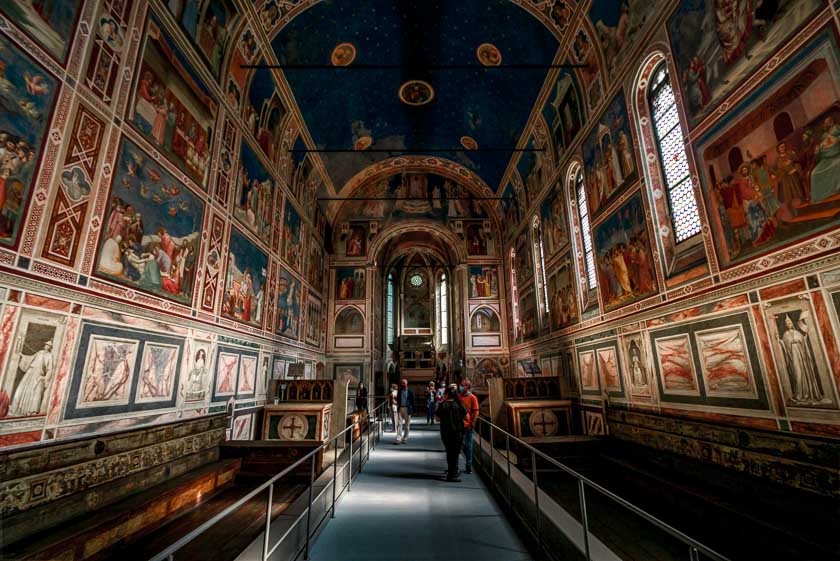
In my opinion, visiting the Scovegni Chapel is the most important thing to do in one day in Padua! (Although it may be a close second to the Basilica of St Anthony below). I traveled to Padua, Italy primarily to see the Srovegni Chapel and it remains one of the most extraordinary and memorable religious sites and artwork I’ve seen to this day.
The Scrovegni Chapel, also known as the Arena Chapel, a UNESCO World Heritage site is just a short walk from Prato della Valle.
It is world-famous for its stunning frescoes painted by the great artist Giotto di Bondone in the early 14th century. One of the most famous frescoes in the chapel is the Last Judgment, which covers the entire western wall.
Visiting the Scrovegni Chapel requires some planning. Due to its fragility, entry is limited to small groups, and advance reservations are mandatory. The entry fee includes a short video and a guided tour that lasts around 30 minutes. Photography without flash is permitted.
Book A Walking Tour of Padua that Includes the Scrovigni Chapel Here —>>>>>

3. Visit Italy’s Greatest Pilgrimage Site: the Basilica of Saint Anthony of Padua
📍: Piazza del Santo, 11, 35123 Padua PD, Italy. A major landmark, it is a stop on the SIR1 tram line.
🎟️: Basilica: Entrance to the main church is free.
- Museums: To visit the Anthonian Museum, Museum of Popular Devotion, and Oratory of St. George, a single ticket is required. You can purchase this on-site. The cost as of July 2025 is €2.50.
🕰️: Museums: Tuesday to Sunday, 9:00 AM to 1:00 PM and 2:00 PM to 6:00 PM. Closed on Mondays and Christmas.
You can find detailed schedules for masses and visiting on the Basilica’s Official Website. Basilica: Open daily from 6:20 AM to 7:00 PM. This helpful post on Reddit suggest the area where the remains of Saint Anthony are viewed is closed during lunch hours – so be mindful of that if you want to see that!
The Basilica of Saint Anthony, also known as Basilica di Sant’Antonio, is one of Padua’s most famous religious sites and perhaps the most important pilgrimage destination in all of Italy. It’s dedicated to Saint Anthony of Padua, a beloved saint known for his powerful preaching and expert knowledge of scripture.
Saint Anthony of Padua had a fascinating life. Whether you are Roman Catholic or not – I really enjoy learning about the Saints!
Saint Anthony was born in Portugal, and ended up doing much work with Saint Francis himself in Italy, then spent the latter half of his life in Padua. He was particularly well-known for his preaching and teaching.
Read the Encyclopedia Britannica article to learn more about Saint Anthony of Padua —>>>
Look for the impressive domes reminiscent of St. Mark’s Basilica in Venice. Make sure you leave time in your itinerary to go inside! Look out for the high altar, designed by Donatello and adorned with bronze reliefs and statues, which show scenes from the life of Saint Anthony and other saints.
The basilica also houses several chapels, including the Chapel of the Relics, where some of Saint Anthony’s relics are kept and venerated…in particular his tongue! As he was known as a powerful preacher, his tongue is on display. This was one of the most surprising relics I’ve seen in my spiritual travels!
One of the basilica’s most beautiful features is the Chapel of the Virgin Mary, also known as the Cappella della Madonna Mora. This chapel contains exquisite frescoes and a revered statue of the Virgin Mary.
Another highlight is the Cappella del Tesoro (Treasury Chapel), which has an impressive collection of votive offerings and historical artifacts donated by pilgrims over the centuries.
When you visit, don’t miss exploring the cloisters and the courtyards. I also recommend you consider visiting one or all of the museums connected to the Basilica of Saint Anthony of Padua. There are three museums, but one ticket for a mere 2.50 Euro will get you into all of them! You can also buy your Baptisty and diocese museum ticket ahead of time easily here! The museums house more relics, a multi-media presentation of the life of Saint Anthony, and a collection of the offerings people have made to the Saint over time.
Learn more about the Basilica Museums Here —>>>
4. See Europe’s Largest Medieval Hall at the Palazzo della Ragione
📍: Piazza delle Erbe, 35100 Padova PD, Italy. The entrance is via the “Scala dei Ferri” staircase on Piazza delle Erbe. The building sits between Piazza delle Erbe and Piazza della Frutta.
🎟️: Tickets can be purchased on-site or pre-booked online via Vivaticket to guarantee entry.
- Price: A full-price ticket is €8.00 (with a €1.00 surcharge if booked online, so €9.00). Reductions are available, and tickets are free for children under five and persons with disabilities and their caregivers.
🕰️: Tuesday to Sunday, 9:00 AM to 7:00 PM. The last admission is 30 minutes before closing. Closed on Mondays (unless it’s a holiday), Christmas Day, and New Year’s Day. You can verify hours and book tickets on the Padova Musei Civici website.
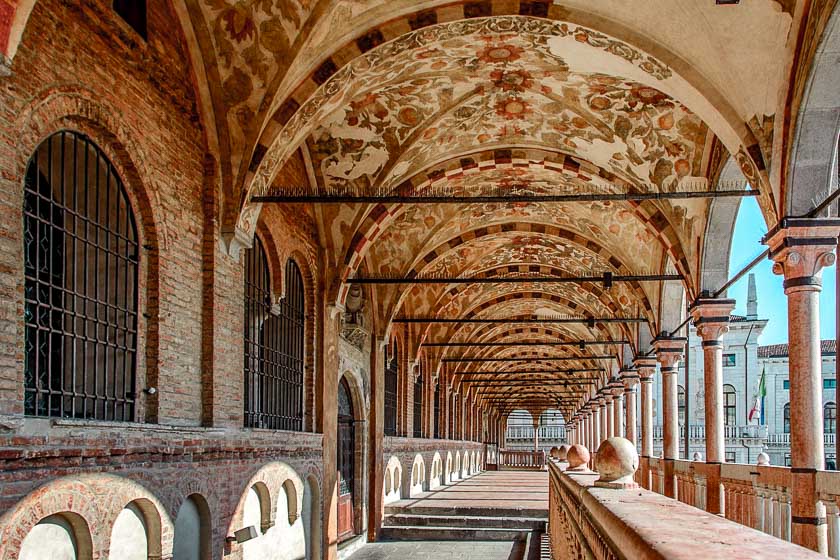
The Palazzo della Ragione, often called the Palace of Reason, is located in Piazza delle Erbe; this large square and palace flanking it has been central to Padua’s civic life since its construction in the 13th century.
One of the most beautiful features of the Palazzo della Ragione is its enormous hall on the upper floor, known as the Salone. It can be a bit tricky to find the stairs to the upper floors of this large square and palace. I advise you to walk around the building with some patience while you find them! Pay the small entrance fee directly there, and then go up to see the Salone. This hall, built in 1219 and measuring over 80 meters in length, is often cited as one of the largest medieval halls in Europe without supporting columns.
The walls of the Salone are adorned with hundreds of vivid frescoes created by various artists over the centuries. These frescoes show scenes from medieval life, the zodiac, and religious imagery. The frescoes here are similar in style to those painted by Giotto in the Scrovigni Chapel above.


5. Visit the Clock Tower in Padua’s Piazza dei Signori
📍: Piazza dei Signori, 28, 35139 Padova PD, Italy. The tower is the dominant feature of the square, located between the Palazzo del Capitaniato and Palazzo dei Camerlenghi.
🎟️: Visits inside the tower are by guided tour only and booking is mandatory.
- Where to Buy: Tours are free but must be reserved by emailing the volunteer association at salvalarte@legambientepadova.it.
- Price: Free.
🕰️: Tour times vary by season. Tower can be viewed from the outside any time!
Alongside Piazza delle Erbe is Piazza dei Signori, which is often quieter than Piazza delle Erbe. Look out for the beautiful Clock Tower (Torre dell’Orologio), an impressive astronomical clock that dates back to the 15th century.
Piazza dei Signori is surrounded by several more historic buildings, including the Loggia della Gran Guardia and the Palazzo del Capitaniato.

One Day in Padova: Where to Go for Lunch
After a morning of sightseeing through Padua, take a break and enjoy lunch at one of Padua’s many excellent restaurants and cafes.
Try local dishes such as bigoli in salsa (thick spaghetti in anchovy sauce) or risotto al nero di seppia (squid ink risotto). For dessert, indulge in a gelato (lemon is always my favorite!) or a traditional tiramisu.
After visiting the Basilica of Saint Anthony, here are two great places within a quick walk to enjoy some of these dishes:
- Caffè Pedrocchi: A bit further away but worth the walk, this iconic cafe offers a blend of light meals and traditional Italian dishes in an elegant setting. You can also visit later on as one of your afternoon activities.
- Enoteca dei Tadi: Located in the historic center, this wine bar and restaurant offers a modern dining experience focusing on regional dishes and local wines.
An alternative option is to buy some picnic food at Piazza delle Erbe and eat before you visit the Basilica of Saint Anthony.

How to Spend the Afternoon in Padua, Italy
Depending on how long you spend at each one, you may only have time to do 2-3 of these activities in one afternoon. Think about your interests and whether you’d like to visit a historic university or the world’s oldest botanical garden, learn about the Jewish heritage of Padua, visit more lively squares, or relax after a busy morning and people-watch from a cafe.

6. Visit The World’s Oldest Botanical Garden: Orto Botanico in Padua
📍: Via Orto Botanico, 15, 35123 Padova PD, Italy. It is located near the Basilica of St. Anthony.
🎟️: Tickets can be purchased at the entrance or booked online via their official website to ensure entry. Price: Full price is €10.00. Reductions are available for students, seniors, and families.
🕰️: Hours vary significantly by season. For example:
- April – September: 9:00 AM to 7:00 PM.
- October & March: 9:00 AM to 6:00 PM.
- November – February: 9:00 AM to 5:00 PM.
Last admission is 45 minutes before closing. Always check the Official Orto Botanico Hours Page for the exact times on your date of visit.
Orto Botanico is the world’s oldest academic botanical garden, established in 1545. This UNESCO World Heritage Site offers a peaceful escape from the city and is frankly just very cool! Discover a variety of plant species, from medicinal herbs and ancient trees to exotic flowers and rare plants. The Orto Botanico is certainly worth the entrance fee if you have any interest in gardens or are looking for a place to rest in the shade and green!
The garden’ features themed areas such as the medicinal plant garden, the palm house, and the aquatic plants section.


7. See the Palazzo Bo and the Famous University of Padua
📍: Via VIII Febbraio, 2, 35122 Padova PD, Italy.
🎟️: Entry to the historic areas like the anatomical theatre is by guided tour only. Adult tickets are €8.00 with a reduced rate for students etc. Family tickets are available for two adults and up to three children for €18. You can purchase tickets at the official website. If you wish to combine the Bonatical Garden above, the Palazzo Bo, and the Museum of Nature and Humankind, you can purchase a “City of Science” Ticket.
🕰️: English tours run at 11:30 AM and 4:30 PM, lasting 45 minutes. You can view the latest times here.
In the afternoon, visit the Palazzo Bo, the historic seat of the University of Padua, one of the world’s oldest universities. Established in 1222, the university has a history of academic excellence and innovation.
Explore the beautifully preserved anatomical theatre, where dissections were conducted for medical students.
Discover lecture halls with historical plaques, portraits, and statues honoring the university’s illustrious scholars.
Famous people such as Galileo Galilei, who lectured here in the late 16th century, and Elena Lucrezia Cornaro Piscopia, the world’s first woman to receive a university degree, have left a big mark on the university. (You can visit the desk where Galileo lectured from!)
Don’t miss the Sala dei Quaranta, where portraits of forty distinguished alumni line the walls. These celebrate the university’s long tradition of academic achievement.
The English tours take place at 11:30 AM and 4:30 PM and last 45 minutes. You can view the latest times here.
8. Explore Padua’s Jewish Neighborhood
📍: The historic area is centered around Via San Martino e Solferino, 35122 Padova PD, Italy.
🎟️: Free to explore the neighborhood. The Jewish Museum and Synagogue require an entrance fee. You can also Book Your Tour of Padua’s Jewish Neighborhood Here.
🕰️: The neighborhood streets are always open. Check the Jewish Museum of Padua’s official website for tour and opening times.
Continue your exploration with a visit to Padua’s Jewish Neighborhood. In this historic area, you can learn more about the religious heritage of the Jewish community in Padua.
Established in 1603, this area was once a hub of Jewish life and tradition. Today, its narrow streets and alleys retain a unique charm.
Spot the major landmarks such as the Synagogue and the Jewish Museum of Padua, which houses artifacts and exhibits that tell the story of the Jewish community in Padua. The area is also home to several kosher restaurants and shops.
Take your time to explore the hidden corners and learn about the resilience and contributions of Padua’s Jewish population. If you have any interest in religious and spiritual history in Europe (as you know I do!), I highly recommend taking time to explore Padua’s Jewish quarter and explore the Synagogue!
Book Your Tour of Padua’s Jewish Neighborhood Here —>>>

9. End Your Day at Padua’s Famous Caffè Pedrocchi
📍: Via VIII Febbraio, 15, 35122 Padova PD, Italy.
🎟️: Free to enter; you pay for any food or drinks you order. Items range from €1-€120 for a full tasting menu by reservation only!
🕰️: Open 8 AM to 12 AM every day (see the Official Caffè Pedrocchi website for up-to-date info.)
End your afternoon with a visit to Caffè Pedrocchi, one of Padua’s most historic cafes. Established in 1831, this grand cafe has been a gathering place for intellectuals, artists, and prominent figures for nearly two centuries.
Take a moment to relax and enjoy a coffee or a traditional Venetian aperitivo. Whether you sit inside among the unique decor or outside on the terrace, the ambiance is perfect for unwinding after a day of exploring.
While you’re here, don’t miss trying the Pedrocchi Coffee, a combination of mint and coffee served without milk that has become the cafe’s signature drink. You can also enjoy the lovely selection of pastries or a light snack.
One Day in Padua: How to Spend the Evening in Padua
If you are spending one day in Padova and you are lucky enough to still be there in the evening, there are many fantastic places to eat dinner, and you’ll get to see the city in a different light.
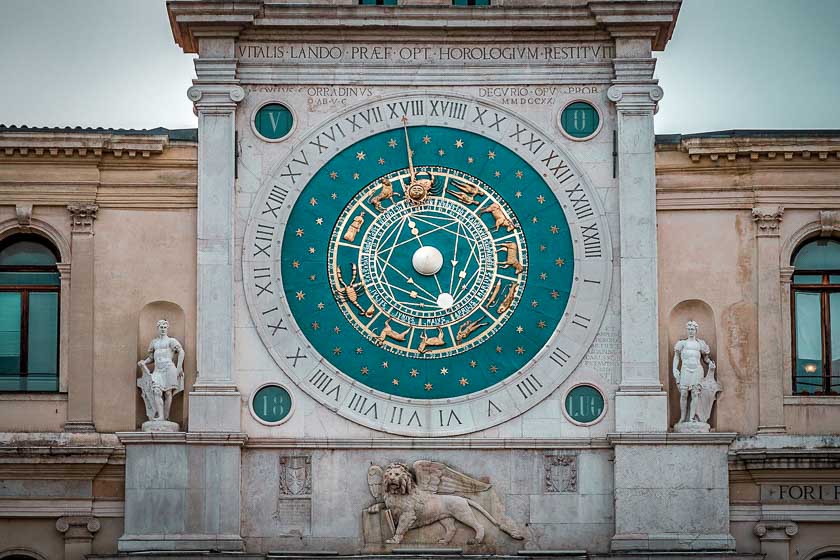
10. Enjoy Dinner Al Fresco in the Piazza dei Signori
📍: Piazza dei Signori, 35139 Padova PD, Italy.
🎟️: Free to enter the square. Dinner prices vary by restaurant.
🕰️: The square is open 24/7; restaurants are typically open for dinner from 7:00 PM onwards.
Head back to Piazza dei Signori to enjoy Padua’s lively evening scene. There are plenty of cafes and restaurants to choose from – some with outdoor seating.
Try dishes like baccalà alla vicentina (salted cod) or fegato alla veneziana (Venetian-style liver).
Here are our top dinner recommendations:
- Osteria Dal Capo– A charming spot known for its fegato alla veneziana and a great selection of local wines.
- Trattoria Al Prato – Offers a delightful menu featuring baccalà alla vicentina and other regional specialties, all in a warm, inviting atmosphere.
An alternative option is to eat dinner at your hotel. Some of our recommendations have lovely restaurants.

11. Take an Evening Stroll Along Padua’s Canals
📍: The main river is the Bacchiglione, with various canals branching off. A particularly scenic area is the Riviera Tiso da Camposampiero, near the former city walls.
🎟️: Free.
🕰️: Accessible 24/7. Best enjoyed in the evening when the lights create a beautiful atmosphere.
End your day with a walk along one of the beautiful canals in Padua, Italy. Padua is very close to Venice, Italy and has some canals of its own! The city’s waterways are beautifully illuminated at night, making them even prettier.

Where to Stay in Padova for One Night
If you’re staying one night in Padua, it’s always best to prioritize choosing a central location so that you don’t spend too much of your day traveling to the hotel and can travel onwards the following day.
If you are going to spend time in Venice, I highly recommend considering sleeping in Padua as a home-base and visiting Venice during the day. Although I have also stayed directly in Venice and enjoyed it!
Search here for the best places to stay in Padua if you are staying 2-3 nights —>>>>>
In good news, although the city is small, there are lovely central hotels in Padova that suit all budgets.
Budget: Hotel Casa del Pellegrino
Budget: $
Star Rating: 3*
Hotel Casa del Pellegrino is the perfect choice for a budget stay in an ideal location. It is just steps away from the Basilica di Sant’Antonio and 50m from a bus stop.
Enjoy dining at one of the two on-site restaurants.
Rooms sleep 1-4 people, depending on the room type chosen.
Hotel Grand’Italia
Budget: $$
Star Rating: 4*
Hotel Grand’Italia Residenza d’Epoca is located near the train station and a short walk from the city center. The spacious rooms have everything you’ll need for a comfortable stay.
Enjoy a complimentary breakfast before your onward travels from Padua.
NH Padova
Budget: $$$
Star Rating: 4*
This upscale hotel is just a short walk from the city center and 10 minutes from the train station.
The NH Padova has a gourmet restaurant on the 12th floor, which offers panoramic city views. There’s also a fitness center and personalized concierge assistance. Rooms sleep 2-4.
How To Get to Padua, Italy
Padua is easily reachable by train, car, or plane from other parts of central and northern Italy and nearby European countries. It is most frequently visited as a day trip from Venice or used as a ‘home base’ to visit Venice for one day!
From Venice Marco Polo Airport and Venice City
One of the nearest airports to Padua is Venice Marco Polo. You can take a direct bus or bus and take a train to Padua from the airport. You can take ATVO Mestre Express to Venice Railway Station, then the train to Padua.
It is also possible to fly into Milan’s Airport or take the train to Milan and then travel to Venice via train. Milan is another wonderful city in Italy for beautiful churches and frescoes!
Take the Train to Padua
Padua’s main train station is a major hub in the Veneto region and is well-connected to other Italian cities. Italy has one of my favorite train systems in all of Europe – and it’s very reasonably priced (I’ve even gotten to ride first class for just a few Euros more!)
Regular train services run from cities like Venice, Milan, Florence, and Rome.
The train station is conveniently close to the city center. High-speed trains can get you from Venice to Padua in about 30 minutes.
Driving to Padua
If you prefer to drive, Padua is well-connected by road. It is accessible via the A4 motorway between Turin and Trieste, passing through Venice. This makes Padua a great stop on a road trip through Northern Italy. Parking is available in several locations around the city center.

How to Get Around Padua, Italy
Padua has excellent public transport, and it’s a very walkable city. Exploring on foot is the best way to see Padua in one day.
Many main attractions, such as Prato della Valle, the Scrovegni Chapel, and the Basilica of Saint Anthony, are within a short walk from the train station and from each other! Taxis are also readily available and can be hailed on the street.
The network of buses and trams can also get you from A to B fast:
- Tram Line SIR1: This tram line runs from the northern to the southern parts of the city, passing through key points such as the train station, Prato della Valle, and Basilica di Sant’Antonio.
- Buses: Bus routes cover the entire city, including routes to the University of Padua, the Botanical Garden of Padua, and other popular destinations.
- The Hop-on Hop-Off Bus: This tourist bus is a convenient way to see all the must-visit attractions and sights in a day, so you can save energy when walking around the sites. The 24-hour ticket also includes on-board commentary.
Frequently Asked Questions about Visiting Padua, Italy
Is one day enough to visit Padua?
Absolutely! One of the best things about Padua is that it’s a very compact and walkable city. A single, well-planned day is the perfect amount of time to see the main highlights, including the Scrovigni Chapel and the Basilica of St. Anthony, without feeling overly rushed. This itinerary is designed to show you exactly how to experience the best things to do in Padua on a day trip from Venice or Milan, or as a stop on a larger Northern Italy trip, such as one that includes another of my favorite cities: Verona, Italy.
What are the absolute must-see attractions in Padua?
If you only have time for a few things, the number one, can’t-miss attraction is the Scrovigni Chapel. It is a world-renowned UNESCO World Heritage site containing breathtaking frescoes by the artist Giotto, and it’s the primary reason many people visit. The second most important site is the massive and beautiful Basilica of Saint Anthony of Padua, a major pilgrimage destination. After those, wandering through the enormous Prato della Valle and the historic market squares like Piazza delle Erbe should be at the top of your list.
Do I need to book tickets in advance for attractions in Padua?
Yes, for the most important one! It is mandatory to book your tickets for the Scrovigni Chapel well in advance. Due to the delicate nature of the frescoes, entry is strictly limited to small groups on a timed schedule, and tickets sell out, especially during peak season. For most other attractions, like the Basilica of St. Anthony or the Palazzo della Ragione, you can typically purchase tickets upon arrival.
Is Padua a good day-trip from Venice or base to explore Venice?
Both! Padua is an excellent and very popular day trip from Venice, as it’s only a 30-minute train ride away, making it easy to see the highlights and return. However, it’s also a very smart travel strategy to use Padua as your “home base” for visiting Venice. Hotels in Padua are often significantly more affordable than in Venice, and it allows you to enjoy a wonderful, less-crowded city in the evenings after spending your day among the canals.
Padua is one of the most beautiful cities in Northern Italy and is well worth a visit if you’re in the area, even if you end up with one day in Padua. The city is also ideal for longer stays. However long your visit is. The city will stay with you forever.
More Travel Resources from Sacred Wanderings
💳 Best Travel Credit Cards:
✈︎ For years I’ve been loyal to American Express, and these days exclusively use American Express Platinum whenever I can. The travel benefits on the Platinum Card are 100% worth the steep fee if you use them consistently. The built-in travel insurance has been a godsend and each of the last two years has fully covered the annual fee for me.
✈︎ Check out American Express Platinum and its benefits here.
✈︎ I also carry the Venture Rewards card as an Amex alternative since some countries aren’t great about American Express. The 2x points per dollar is a great incentive for Venture Rewards!
✈️Find Cheap Flights:
✈︎ Most travel bloggers don’t recommend Google Flights for one reason: bloggers don’t make a commission off of them. But here’s the thing – I still think Google Flights is the best platform for finding cheap flights and comparing different options! It’s what I use daily. I appreciate the alerts feature as well, and it will notify me if a flight I’m watching is likely to go up in price.
✈︎ As an alternative, Expedia has a good search platform for flights and I occassionally see deals there I didn’t find anywhere else.
💶 Travel Insurance:
✈︎ Do not forget to purchase comprehensive travel insurance, especially for international travel or if you are international coming to the USA. I always use SafetyWing Travel Insurance to make sure I’m covered for medical bills abroad, and have always been very happy with their service and pricing. They have great options for long-term travel, too, and provide insurance that includes the USA and covers Covid-19.
Author Bio

Cate Michelle previously served as pastor to the oldest Mennonite church in the United States (founded in 1683!) and now writes about religious travel and is an Assistant Professor in the area of Religion, Health, and Human Values. She particularly enjoys spending time in Europe exploring Europe’s fascinating religious and spiritual heritage through its monasteries, cathedrals, and basilicas. She has spent summers living in a monastery in Switzerland and is currently working towards degrees at Oxford and KU Leuven, Belgium.
This post may contain affiliate links. That means I earn a small commission for products or services mentioned on this site. As always, all opinions remain my own. For more information please see our Privacy Policy.