What is the Difference between Amish and Mennonite? 7 Fascinating Differences
Last Updated on: 30th June 2024, 11:26 am
If you are planning on visiting the Amish in Pennsylvania, Ohio, or many of the other areas the Amish and Mennonites live in the USA – you might be asking: What is the difference between Amish and Mennonite?
I write openly here on Sacred Wanderings about being a Mennonite myself – though not by birth: I converted when I was 20. I also previously served as Pastor to the oldest Mennonite congregation in the USA, founded in 1683. I am here to give you a comprehensive guide to understanding the key difference between Amish and Mennonite! The differences are deeper than their relationship to modern technology, and are rooted in religious beliefs and history that goes back to the 16th century.

Quick Guide to Difference between Amish and Mennonite
1.Church Discipline: Following their founder, Jakob Amman, who broke off from Mennonites, the Amish practice a stricter form of church discipline which makes it harder to shift with the changing culture.
2.Organization: The Amish are more strictly congregationalist or district-based, and so church leaders in each district have huge leverage over accepted practice, like head covering. Mennonites has some independent districts, and also some larger denominations like Mennonite Church USA.
3.Strict Separation: The Amish tend to follow strict seperation from the world whereas even more conservative Mennonites will practice more integration with modern society. Modern mennonite congregations practice wearing mostly normal clothes and do not use buggy transportation.
Commonalities:
1.Adult Baptism & Pacifism: Both groups share common historical roots, are Anabaptist groups (not Protestant nor Catholic), practice adult baptism, and pacifism – including being conscientious objectors, not participating in any military service.
2.Engagement with Technology: Both Amish and Mennonites will try to engage with technology in meaningful ways with reflection for what is best for the community and spiritual life.
3.Language and Geography: While most Amish reside in the United States, there are conservative Mennonite groups in Mexico, Paraguay, and Bolivia and more modern Mennonites all over the world – including more in West Africa than in the whole United States due to previous missionary work.


Historical Roots of the Difference between Amish and Mennonite: Religious Beliefs
The Amish and Mennonites both belong to a larger “umbrella” religious group that is distinct from Protestants and Catholics called Anabaptist. The word actually means “re-baptized” as the major break with the Protestant church came when certain men re-baptized themselves in Switzerland because they did not believe their Protestant infant baptism counted. At this time, there was no word for Mennonite nor Amish – only “Swiss Brethren” or Anabaptist.

The Radical Reformation and Anabaptist Origins
The Amish and Mennonites share a common origin in what we call the Radical Reformation, a 16th century movement that represented the extreme wing of the broader Protestant Reformation.
Unlike the more mainstream reformist leaders like Martin Luther and Zwingli, the Radical Reformers rejected not just the authority of the Roman Catholic Church, but also the concept of infant baptism.
The Radical Reformers, who became known as the first Anabaptists (“re-baptizers”), believed strongly that church membership should only come through adult voluntary baptism. At the time, this represented not only a break with the Protestant church, but also a break with the state – as baptism was also essentially birth registration and required in Switzerland and Germany.
Because of their refusal to follow church and state laws, the Anabaptists faced fierce persecution from both Catholic and Protestant authorities across Europe.
Somewhat due to the horrors of the persecution, and the strength of Anabaptist conviction, Anabaptist ideas spread around Northern Europe.
One of the key figures became Menno Simons (1496-1561), who was a Dutch Catholic priest who left the church in 1536 after being inspired by the Anabaptist teachings – and also became pacifist after his brother was murdered by the Catholic Church for resisting. Simons became a key leader who helped solidify the Anabaptist movement, which grew considerably under his guidance. That’s why we are called Mennonites today!
Over the next century and a half, the Mennonites faced waves of intense religious persecution, imprisonment, torture and further execution for their beliefs. Many were martyred across Switzerland, Germany, the Netherlands and other regions. It is estimated more than 100,000 Anabaptists may have been killed, largely by burning and drowning, during this time. This martyrdom sowed the seeds for the Anabaptists to migrate for the religious freedoms promised in North America.
Read more about Anabaptist History on the Global Anabaptist Mennonite Encyclopedia Online —>>>>

Jakob Ammann and the Amish Split
While the Mennonites maintained many traditional Anabaptist practices, there were debates over how strict members needed to be regarding church discipline. In 1693, a Swiss Anabaptist leader named Jakob Ammann (or Jacob Ammann) felt the rules were not being followed strictly enough. He criticized things like inadequate shunning of ex-members, the practice of having brass rings for horse teams instead of leather straps, and allowing too much acculturation to the outside world.
Ammann pushed for a separatist group and a totally seperate lifestyle that would adhere to a plainer and stricter way of life. This culminated in a formal split with the Mennonites in 1693, with Ammann’s more conservative followers becoming known as the Amish (based on Ammann’s last name).
Although we still have a lot of similarities and shared history, from this point on, the Amish and Mennonites maintained their own distinct groups, beliefs and practices.


Amish and Mennonite Migration to America
Due to the persecution both Mennonites and the new Amish group continued to face in Europe, both the Amish and Mennonites eventually migrated to the British colonies in North America.
The first major permanent Mennonite settlement was established in Germantown, Pennsylvania in 1683. The Mennonites were enticed by William Penn’s vision of religious freedom, and have long lived in close community with the Quakers as a result.
Over the next few decades, thousands of Mennonites followed from Germany, Switzerland, and Ukraine and Russia where large Mennonite populations had grown.
The first major wave of Amish immigrants in large numbers arrived in Pennsylvania in the 1730s – after the first Mennonites. The Amish settled across what is now eastern Pennsylvania, Ohio, Indiana, Illinois and other regions that offered affordable farmland and the ability to maintain their traditional agrarian ways of life isolated from the outside world.
The Amish also continued to speak Low German (what we call Pennsylvania Dutch..but it’s actually German not Dutch at all!) where most Mennonite groups adapted to speaking English.

Interested in learning more about the Amish and visiting the Amish around the USA? See all of Sacred Wanderings Amish Content Here —>>>>
Main Difference Between Amish and Mennonite Today
While the Amish and Mennonites share roots in the Anabaptist tradition, over the centuries the different groups evolved with some key differences in religious practices and cultural norms. However, it’s important to note that both the Amish and Mennonites adhere to the same basic Christian doctrine – and much of that doctrine doesn’t look too different from Protestant beliefs, except for believing that Jesus called us to always be pacifist.
1. Technology Use
One of the starkest contrasts between the different Amish and even Mennonite sects comes in the use of modern labor-saving technologies. The Amish generally reject power tools, appliances, computers and other electronic devices. While some Mennonites do limit technology use, many contemporary Mennonites embrace modern technology with thoughtfulness and discernment.
2. Transportation
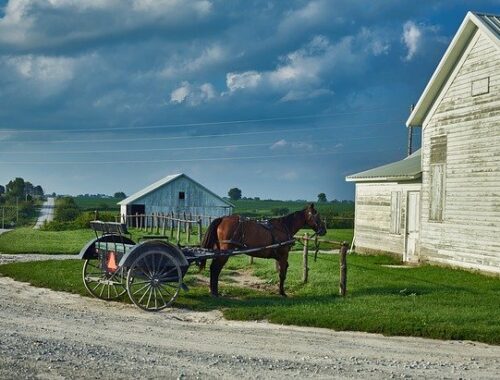
The Amish typically travel by horse-and-buggy and are prohibited from owning or operating automobiles and other motorized vehicles. However, the Amish are almost always allowed to accept a ride in cars – though they cannot drive them. Most Mennonites drive cars, although some groups stick to only driving “black bumper” or very plain black cars so as not to practice vanity. Personally, I drive a Prius which a lot of Mennonites I know drive!
3. Clothing
The Amish have a very plain and modest dress code, with women wearing capes and long dresses. Amish-type dresses are usually plainer colors, while you can tell a conservative Mennonite group because the dresses will be more colorful even if they still dress conservatively. Amish men often wear plain suits and straw hats. Mennonite dress today is typically a bit more modest than mainstream society, but there is much flexibility within Mennonite culture.
If you are in Lancaster, PA for instance, one of the easiest ways to tell the difference between Amish and Mennonite is the headcovering: Mennonites wear a kind of stiff mesh covering that is pleated and round, while Amish wear a heart-shaped white cloth covering.
4. Language
The Pennsylvania Dutch language (which is a form of German) is still spoken among many Amish communities although almost all Amish do speak English, while most Mennonites in the USA mainly use English. Since there are many Mennonites in Central America and West Africa, Spanish and French are increasingly used amongst Mennonites today.
5. Education
Amish children usually only receive formalized schooling through 8th grade, with a focus on agricultural/vocational skills. Higher education is much accepted in Mennonite communities and there are a number of well-respected Mennonite colleges and universities, such as Goshen College, Eastern Mennonite University, and Bluffton in Ohio.
6. Degree of Separatism from the World
While both seek to maintain separation from the broader world, the Amish live in tighter, more insular communities isolated from mainstream culture and society. Mennonites participate more freely in the outside world although sometimes are still perceived to be a bit insular – somewhat because we maintain a lot of close community practices such as spending a lot of time at each others’ homes, raising our children in community, and serving through volunteering together.
7. Church Governance
The Amish practice a congregational model with no centralized authority, so each bishop or church leader has a lot of power to decide what each district practices. Some Mennonite groups have more formal denominational structures in place such as Mennonite Church USA and Canada, but others remain independent.

One of the other quirks of Mennonite life which applies to both the Amish and Mennonite is that due to the history of migration and close-knit churches, a lot of modern Mennonites and Amish within their communities are related. Unfortunately, there are a few common genetic diseases known primarily amongst these groups as a result of a founder effect, such as Maple Syrup Urine Syndrome. Even amongst my very modern and progressive Mennonite friends, most of them are at least second cousins if not closely related.

Diversity Within Each Group
Like almost all religious groups today, it’s also important to recognize that there is a wide range of diversity and different subgroups within both the Amish and Mennonite communities when it comes to how conservative or progressive individual churches are.
Among the Amish, the most conservative branch are the Old Order Amish, who strictly follow the traditional plain lifestyle and reject most modern technologies and conveniences. Groups like the New Order Amish and the Beachy Amish are considered more progressive, allowing for certain technological exceptions like tractors, rearview mirrors on buggies, and so on.
There are even some blend groups like the Amish Mennonites that maintain some Amish beliefs and practices while being more integrated with the Mennonite faith. So the Amish world represents a spectrum of tradition and modernity.
Within Mennonite communities, there are branches that range from very conservative and Amish-like, to mainstream and more progressive groups that embrace modernity and are open and affirming to LGBTQ+ individuals while still maintaining core theological tenets of the Anabaptist tradition.
The most conservative Mennonites are groups like the Old Order Mennonites who share similarities to the Old Order Amish, including plain dress and a prohibition on most technologies. In the middle are groups like the Evangelical Anabaptists, EVANA, the moderately progressive Mennonite Church USA (formed in 2002 after a consolidation) and the Mennonite Church Canada. The first Mennonite church in the USA in Germantown, Pennsylvania in 1683 is now considered the most progressive Mennonite church today, and is fully embracing of LGBTQ+ Mennonites and is very politically active in pacifist and liberal causes.

While their origins are intertwined, today’s Amish and Mennonites display a wide spectrum of religious observance and integration with broader society. But both groups remain rooted in a shared spiritual legacy that has allowed them to preserve their unique traditions against the tides of changing world over centuries.

Frequently Asked Questions about the Amish and Mennonites
Can you Visit or Join an Amish or Mennonite Church?
Sort of…anybody is welcome to join a modern Mennonite church such as churches that are a part of Mennonite Church USA. In fact most of the members of my Mennonite church, like myself, were not born Mennonite! You can search for a Mennonite church near you in the US here. For the most part, it’s difficult to visit or join an Amish church – but absolutely not impossible. The Beachy Amish and Amish Mennonites are a middle grand that is easier to join but still practice plain dress and traditional gender roles.
Can I take pictures of Amish people?
Please do not without asking. The Amish sincerely value humility and photogaphs are in some cases considered a sign of vanity. It’s therefore rude to take a picture of an Amish person close-up without their permission (from talking to some Amish folks I know, it’s not prohibited to take a picture of a large group or someone from far away as that’s not considered individual vanity. I still use discretion!).
But why can’t the Amish use technology?
It’s NOT about the technology. It’s about group cohesion, non-violence (it’s much harder to kill someone with a buggy than with a car), and community discernment. This is why you’ll find Amish communities that DO use technology – such as having internet and phones in the barn in order to facilitate family business that keeps the community together. Many Amish men in Indiana are excellent electricians: it’s a good job that doesn’t require a college education and can support a family when there is increasingly limited farmland. I can’t say this enough: it’s not about the technology itself, it’s about all the bigger considerations and impacts on the community that comes with adopting technology. Even modern Mennonites will have these conversations and be selective and considerate around technology.
Author Bio

Cate Michelle previously served as pastor to the oldest Mennonite church in the United States (founded in 1683!) and now writes about religious travel and is a prominent researcher in religion and healthcare. She specializes in helping healthcare providers best serve religious minority populations (like the Amish) while respecting their beliefs and values. She finds herself in Amish country in Pennsylvania, Ohio, Wisconsin, or Indiana regularly and loves to share her insider knowledge on how to make the most of your visit with the Amish!