

Pilgrimage sites in Mexico: The Best Cathedrals, Shrines, and Temples You Must See
Last Updated on: 18th July 2024, 11:35 am
When most of us think of taking a Pilgrimage, our minds go instinctively to the big pilgrimage sites in Europe and Pilgrimages to the Holy Land in Israel/Palestine. Until I went to Mexico for the first time, I wouldn’t have thought Mexico is one of the best places for a Pilgrimage! There are so many pilgrimage sites in Mexico you could explore and find inspiration fom, most of them for Christians and Roman Catholics. Mexico also hosts wonderful sites related to Mayan and Aztec religious history and culture. Central and South America in general have a wealth of beautiful monasteries and churches, such as in Antigua Guatemala – another fabulous pilgrimage site filled with churches!
Below are the best Roman Catholic Pilgrimage sites in Mexico, along with some of the most important Mayan and Aztec pilgrimage sites if you are looking for a broader cultural adventure!
Mexico is truly one of the greatest countries for a pilgrimage, and it’s very accessible to the United States. Many of these sites can be reached by flying into Mexico City, where there are comfortable coach buses traveling throughout the rest of the country. For sites in the Yucatan, Cancun or Merida are great places to fly into – and driving on your own in the Yucatan isn’t hard, I’ve done it successfully.
But what if you don’t speak Spanish? I’ve traveled extensively in Mexico without speaking much Spanish and my experience has been that people are very willing to help you and it’s possible to have a wonderful experience even with limited Spanish.
The Shrine of Our Lady of Guadalupe, Mexico’s Best Pilgrimage Site

Of all the pilgrimage sites in Mexico, Our Lady of Guadalupe Shrine in Mexico City may be the most famous!
Juan Diego Cuauhtlatoatzin was a Chichimec peasant who was granted four visions of the Virgin Mary in the year 1531 – three of which occurred on a hill just outside of Mexico City, Mexico. When asked by the local Spanish bishop to prove that these visions occurred, Juan Diego brought a cloak filled with red roses (even though it was winter) and when he opened his cloak to show the roses – miraculously imprinted on it was the image of the Virgin he had seen: named the Virgin de Guadalupe.
Today, near the same hill of Tapayac, just outside of Mexico City, you can visit the Shrine to the Virgen of Guadalupe, and see Juan Diego’s legendary cloak with the image of the Virgen.
The Basilica and Shrine of the Virgen to Guadelupe is not only Mexico’s most popular Catholic pilgrimage site, but a pilgrimage to Guadalupe is one of the most popular pilgrimages in the world. Because of the popularity of the site and many people’s desire to see the cloak of Juan Diego, which is said to be responsible for many healings and miracles, there is both an old Basilica and a new church to the Virgen of Guadelupe that houses the cloak.
You can take a bus or a taxi to easily get to the site just outside of Mexico City. The complex is a large one, with many buildings – the two great churches, as well as places for pilgrims to get nourishment, go for prayer or confession, and a very special grotto with statues re-creating the scene at the very place Juan Diego had his visions.
The most important thing to do at this shrine is to go to the newly built, circular church and to get on a moving walkway to look up and view the cloak of Juan Diego. It’s a very moving experience – the image is remarkably bright even though it’s from the 1500s!
Sanctuary at the Great Pyramid of Cholula: Puebla, Mexico

Photo and narrative submitted by Isabella at Boundless Roads.
Puebla, the capital city of the Mexican state of Puebla, is especially popular for its abundance of churches, and incredible food.
There is this saying that in Puebla there is one church for every day of the year and although nobody has actually counted them, if you walk around the city you will notice a beautiful old church on every corner, almost all of them boasting baroque architecture, as a witness to Puebla’s colonial past.
The Sanctuary on top of the Great Pyramid of Cholula is one of the best. A 30-minute bus ride from Puebla, the popular sanctuary, also known as Tlachihualtepetl (“made-by-hand mountain” in Nauatl language), is actually the biggest pyramid in the world by volume. In fact, although it’s much shorter than the Great Pyramid of Giza in Egypt, it is much larger by far.
The complex is not only a major Roman Catholic pilgrimage destination in Mexico – but it was also a very important religious center in the pre-Hispanic times.
The pyramid itself is a temple that was originally dedicated to the Mayan and Aztec God Quetzalcoatl.
After the arrival of the Spaniards a church was built on top of the pyramid called the Iglesia de Nuestra Señora de los Remedios (Church of Our Lady of Remedies), also known as the Santuario de la Virgen de los Remedios (Sanctuary of the Virgin of Remedies).
Inside the pyramid, there are five miles (8.0 km) of tunnels excavated by archaeologists which visitors can explore and visit either by themselves or by guided tours.
There are local buses that leave from Puebla to Cholula and back. Or you could book a full-day tour from Puebla with a knowledgeable guide to learn more about the interesting history beyond the Sanctuary. While there, do not miss the delicious food in Puebla, including the national dish, chile en Nogada, available from August through October.
San Ignacio Arareko Church in Chihuahua, Mexico
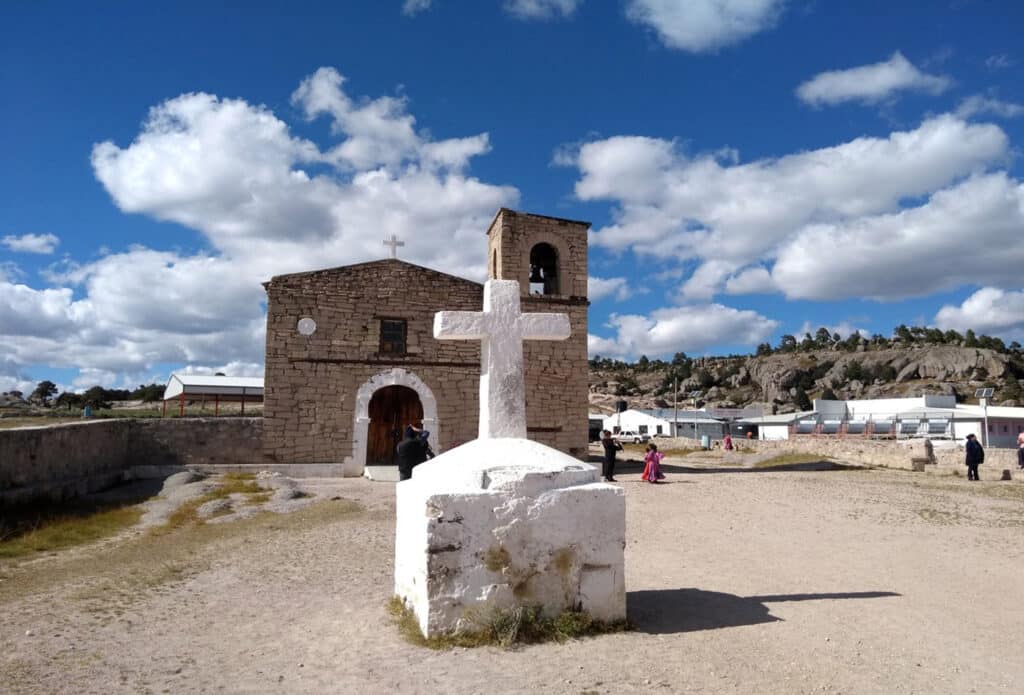
Photo and narrative by Daniel from Layer Culture.
When looking for Pilgrimage Sites in Mexico, one of the most fascinating landmarks to see is the San Ignacio Arareko church located in Creel, Chihuahua which lies southwest of Chihuahua City.
There are 168 Missions in Chihuahua state alone but it is rare to see a church completely unmodified since it was first built by Jesuits in the 16th century.
The building has elements of syncretism and an interesting mix of local traditions with the Catholic teachings of the early Jesuit missionaries. The local Rarámuris were one of the last tribes to be converted and meet at the church every Sunday for worship.
The area is surrounded by a valley of beautiful rock formations and the village of San Ignacio can be visited as part of a day tour. Along with Lake Araeko, which is one of the areas inhabited by the Rarámuri community, you can visit other cultural gems in this magical town.

Catedral Basílica de la Inmaculada Concepción, Mazatlán
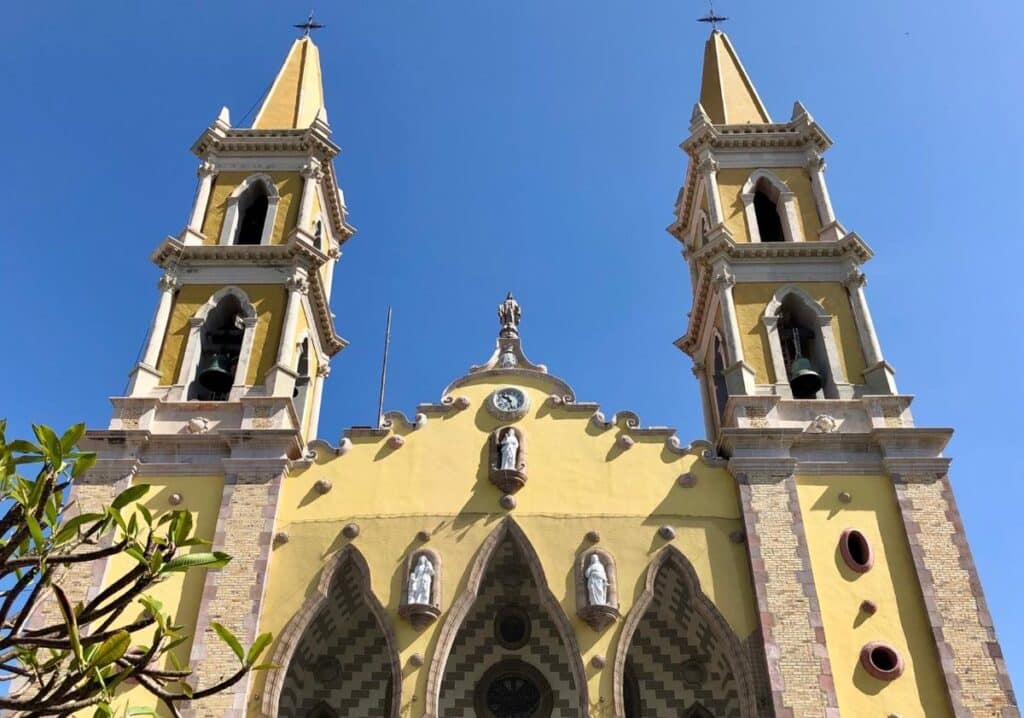
Photo and narrative by Lisa Garrett of Waves and Cobblestones.
Visiting the Catedral Basílica de la Inmaculada Concepción is one of the best things to do in Mazatlán. This cathedral, located in the heart of Mazatlán’s Centro Histórico, is the city’s main religious site.
Construction of the cathedral began in 1856 on the ancient site of an Indian temple. It was finally completed and consecrated in 1899. In 1937, it was elevated to the status of a basilica, which gives it special ceremonial privileges. (Only 27 churches in Mexico have been granted this status.)
The Catedral Basílica de la Inmaculada Concepción is also one of the most beautiful and elaborate churches in Mexico. Mazatlán’s patron saint, the Virgin Mary, is honored over the cathedral’s main altar.
Enjoy the beauty of the light shining through the cathedral’s 28 stained-glass windows and from the ornate chandeliers hanging from its vaulted ceilings. Another special feature of the cathedral is its magnificent organ, which was built in Paris by a famous craftsman.
Visitors on a pilgrimage to the Catedral Basílica de la Inmaculada Concepción can’t help but feel a sense of peace and serenity when surrounded by the beauty of this important religious site.
Talpa De Allende Pilgrimage Site: Jalisco, Mexico

Photo and narrative contributed by Daria at The Discovery Nut.
Located in the state of Jalisco, Talpa De Allende (or Talpa) is one of the best day trips from Puerto Vallarta.
Talpa De Allende is a Pueblo mágico, and while it sits off the beaten travel path, more travelers are starting to discover this hidden gem in the Sierra Madre Mountains.
This small town boasts quiet atmosphere, authentic Mexican culture and several historic landmarks.
Talpa De Allende is also one of the most revered pilgrimage sites in Mexico and it attracts thousands of people every year.
Three times a year Talpa attracts tens of thousands of pilgrims arrive to visit Talpa’s “miracle” Virgin in the shrine of the Virgin Rosario of Talpa.
The shrine in Talpa is one of the most important religious sites in all of Mexico. According to the popular belief, the Virgin of Talpa has healing powers, which attracts people looking for a miracle from all over the country.
The icon is housed in Talpa’s básilica, an ornate two-spired church that faces the main square of Talpa. The town is a perfect place to spend a day or two if you are looking to get off the beaten track and explore the nearby mountains.
The Sanctuary of Atotonilco Near San Miguel de Allende
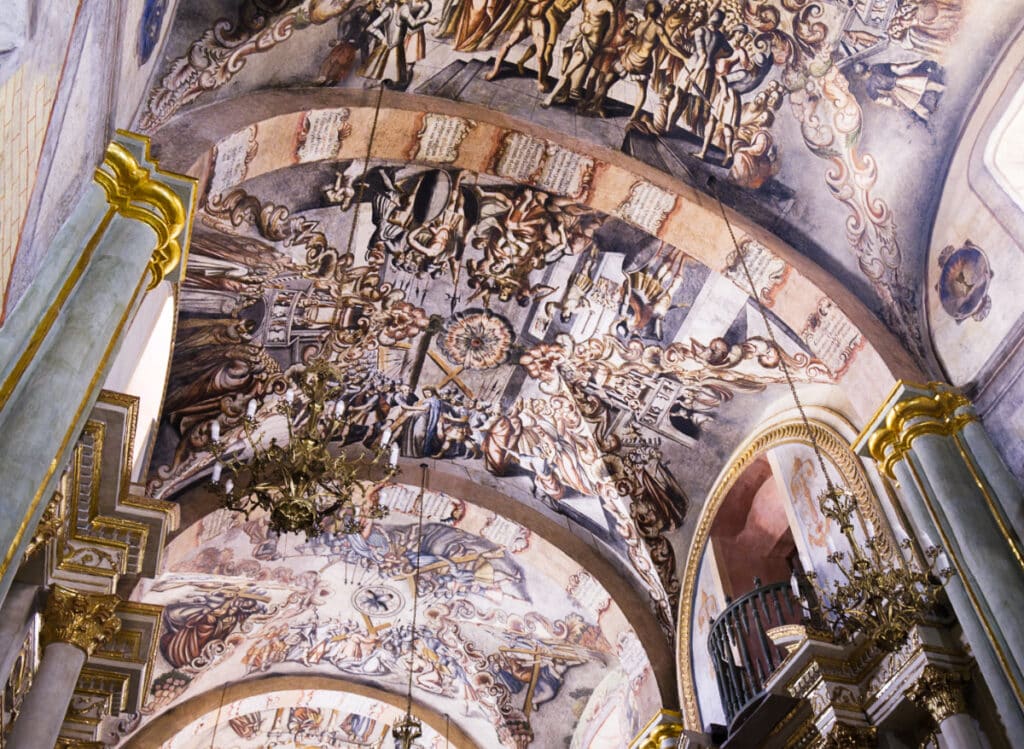
Image and narrative by Julien Casanova at Cultures Traveled.
From the outside, the Sanctuary of Atotonilco looks like a large white fortress nestled in a small Mexican town. However, a visit inside reveals the reason it is referred to as the Sistine Chapel of Mexico.
Covering nearly every inch of the walls and ceiling is a series of murals depicting the life and death of Christ.
The Church was founded in 1740 by Father Luis Felipe Neri de Alfaro. He later commissioned local artist, Antonia Martinez de Pocasangre, to paint the murals over a period of 30 years.
Today the church is a pilgrimage site, especially during Semana Santa when it becomes the starting point of a procession to San Miguel de Allende. It’s estimated that 100,000 pilgrims visit the Sanctuary of Atotonilco each year.
Visiting the church is one of the top day trips from San Miguel de Allende as it’s located near the many hot springs just 12 km (7.5 miles) north of town.
Whether you pair a visit with a morning of relaxing in hot spring baths or not, the Sanctuary of Atotonilco is a must-see when you’re in the area.

From France’s majestic Cathedrals, to its gorgeous monasteries perched on islands and cliffsides — not only are France’s pilgrimage sites filled with beauty, but also with meaning and spirituality. They are some of the best pilgrimages in Europe!
Loreto Mission in Baja California, Mexico

Narrative by Daria at The Discovery Nut.
If you are looking to visit one of the most important historic missions in Mexico, head to Loreto, a small town in the state of Baja California Sur.
Loreto is the first capital of the Californias and home to Misión de Nuestra Señora de Loreto Conchó, or Mission Loreto. The Spanish conquistadors established the mission in 1697 at the Native American settlement in the area after many unsuccessful attempts to colonize the native population of the Baja California Peninsula.
The Spanish constructed dozens of missions across the Californias between 1683 and 1834 to spread Christianity among the Native peoples who lived on the Baja California Peninsula.
Loreto is known as the first successful Jesuit Mission in Baja California.
Loreto was also the first capital of the Californias from 1697 until 1777. From Loreto Spanish rule expanded to Cabo San Lucas and up towards San Diego.
In 1769, Colonel Portolá headed an expedition to Alta California. In 1777 the capital of the Californias was moved to Monterey.
Mayan Pilgrimage Site: Uxmal near Mérida, Mexico

Photo and Narrative by Ashlea J. Russell from She Roams About.
Tucked away in the jungle, some 50 miles southwest of Mérida in Yucatán is the ancient Maya city of Uxmal. Inhabited since as early as 800BC, Uxmal has long been a site of sacred importance to the Maya people and functioned for centuries as a religious, social, and economic hub.
Now a UNESCO World Heritage Site, Uxmal was built to honor Chaac, the Maya god of rain.
Unlike most other prehispanic towns, Uxmal is not laid out geometrically but rather is designed with astronomy at its heart. The buildings in the large 150-acre complex are aligned with the planets as they knew them, with Venus and the sun as the focus.
Uxmal is still considered to be of sacred importance and has been a pilgrimage site since the 10th century AD. The majestic structures are unlike other archeological sites such as Chichen Itzá in that they are rounded with plain, sturdy bases and highly decorative upper faces making Uxmal one of the most impressive examples of Maya art.
The design of Uxmal is believed to represent the perfect balance between feminine and masculine energies and is still visited today as a place to recharge and rebalance.
Planning Your Pilgrimage to Mexico
While the sites highlighted above are scattered throughout the country, one of the best things about Mexico is that no matter where you go there is likely to be an amazing church, basilica, or pilgrimage site near you!
You could spend years exploring all that Mexico has to offer – so my advice is to pick somewhere to start and enjoy it! Mexico City is a wonderful starting point and has a lot to offer the first-time visitor. Don’t be afraid of its reputation as a violent city. While there are some places I would not go – and certainly not at night – much of Mexico City is beautiful and very safe – including the areas around most of its most important churches and pilgrimage sites.
From the airport or downtown Mexico City, you can take a coach bus to almost anywhere else in Mexico: Puebla is only a few hours away, and Oaxaca is 4-5 hours by bus.
If you are interested in going on a group pilgrimage to Mexico, a few companies offer these, mostly with a Roman Catholic focus. Catholic Journeys offers regular departures for a pilgrimage to Our Lady of Guadalupe, including over the Feast Day!
Nativity Pilgrimage can arrange an 8-day Shrines of Mexico Tour.
However you travel to Mexico, I hope your pilgrimage is meaningful and brings you great spiritual hope!


